Continuous Efficiency: AI-Driven Software Optimization with GitHub Agentic Workflows
Paull Young examines how the GitHub Next and Sustainability teams are shaping the future of software optimization through AI-driven Continuous Efficiency, detailing the use of agentic workflows and collaborative automation for greener, higher-performing codebases.
Continuous Efficiency: AI-Driven Software Optimization with GitHub Agentic Workflows
Author: Paull Young
Introduction
This article envisions a near future for software engineering where AI-enabled tools make sustainable, efficient coding nearly effortless. The concept, termed Continuous Efficiency, combines automated performance and sustainability optimizations through advanced developer workflows on GitHub.
Background and Motivation
Currently, digital sustainability and green software rarely receive as much attention as they deserve in everyday development. However, the next wave of AI-enriched developer tooling — as piloted by GitHub Next and GitHub Sustainability — aims to transform this, making always-on, incremental efficiency improvements a standard practice for teams and organizations.
Developer and Business Benefits
- For Developers:
- Improved code performance
- Automatic standardization, quality assurance, and remediation
- For Businesses:
- Lower resource and power consumption
- Higher code quality and user experience
- Cost savings
Concept: Continuous Efficiency
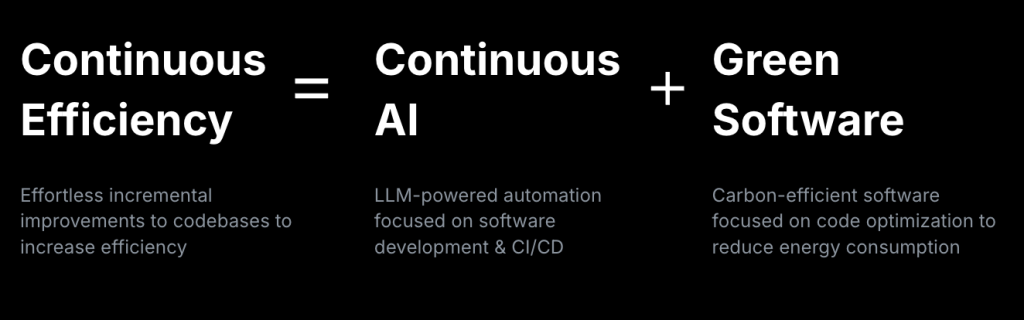
Continuous Efficiency arises at the intersection of Continuous AI (always-on, LLM-powered workflow automation) and Green Software (energy-efficient, lower-impact code).
Key Technologies
- Agentic Workflows:
- Experimental GitHub platform/infrastructure
- Supports proactive, event-driven agents executed within GitHub Actions
- Open source, but currently in prototype/pre-release
- LLMs in DevOps:
- Automated agents use LLMs (like Copilot CLI) to interpret natural language standards and apply changes to code repositories
Case Studies
1. Implementing Rules and Standards
- Expressing engineering standards in natural language, interpreted and applied by LLM-powered agents
- Advantages over Traditional Linting:
- Declarative, intent-based rules (written in plain English)
- Semantic application across languages and architectures
- Automated, platform-integrated remediation (e.g., pull requests, code suggestions)
- Examples:
- Collaboration with the
resolveproject to implement green software rules agentically, leading to measurable performance improvements - Implementing the W3C Web Sustainability Guidelines (WSG) as agentic workflows across various GitHub and Microsoft repositories
- Collaboration with the
2. Heterogeneous Performance Improvements
- Addressing the challenge of optimizing extremely diverse codebases
- Daily Perf Improver:
- Automated, multi-phase workflow that researches, benchmarks, and implements measured optimizations in daily sprints
- Case study: Applied to
FSharp.Control.AsyncSeq, resulting in accepted pull requests and verified performance gains
How Agentic Workflows Work
- Workflow Authoring:
- Written in Markdown with YAML-like front matter and natural language instructions
- Compilation and Execution:
- Compiled to standard GitHub Actions YAML via the
gh aw compileCLI command - Run as sandboxed agents in GitHub Actions, leveraging LLMs for intelligent automation
- Outputs include PRs, comments, and direct code modifications under standard security controls
- Compiled to standard GitHub Actions YAML via the
Building Your Own Continuous Efficiency Workflows
Process:
- Define the workflow intent (public standard or engineering requirement)
- Author the workflow in Markdown (guided by agentic tools)
- Compile to YAML
- Execute in GitHub Actions
Developers can start experimenting with example agentic workflows and contribute their own rulesets.
Get Involved
The GitHub Sustainability team invites developers to try out agentic workflows now, with opportunities for early adopters and collaborators as the practice of Continuous Efficiency expands.
Learn more: GitHub Next: Continuous AI Green Software Foundation
Conclusion
Continuous Efficiency represents a future where proactive, AI-powered automation empowers developers and businesses to achieve sustainable, high-performance software, seamlessly integrated into existing workflows.
This post appeared first on “The GitHub Blog”. Read the entire article here