The Evolution of SSIS: SQL Server Integration Services 2025 General Availability and Microsoft Fabric Integration
Microsoft Fabric Blog details the major advancements and integration features of SSIS 2025 as it becomes generally available, authored by the official product team. The article covers data security, connections to Microsoft Fabric, and technical migration strategies for enterprise users.
The Evolution of SQL Server Integration Services (SSIS): SSIS 2025 (Generally Available)
SQL Server Integration Services (SSIS) has long enabled organizations to manage complex data integration, ETL, and transformation tasks. With the release of SSIS 2025, announced at Microsoft Ignite, the platform aligns with SQL Server 2025 and delivers modern capabilities for hybrid and cloud-first architectures.
Major Features of SSIS 2025
- Enterprise Security
- SSIS 2025 integrates the modern Microsoft.Data.SqlClient for secure data access.
- Advanced security protocols supported, including TLS 1.3.
- Robust authentication using Microsoft Entra ID (formerly Azure Active Directory).
- Strict Encryption with TDS 8.0 default protections for all SSIS network traffic, strengthening data security at rest and in transit.
- Integration with Microsoft Fabric
- SSIS packages can now be targeted at Fabric Data Warehouse, expanding enterprise analytics possibilities.
- Authentication: SSIS must use Microsoft Entra ID credentials; SQL and Windows auth are not supported for Fabric.
- Data Ingestion: Use the T-SQL
COPY INTOcommand as the recommended loading method for Fabric Data Warehouse, superseding fast-insert/BCP scripts.- See: What’s New in Integration Services in SQL Server 2025
-
See: [Tutorial: Integrating SSIS with Fabric Data Warehouse Microsoft Learn](https://learn.microsoft.com/sql/integration-services/fabric-integration/integrate-fabric-data-warehouse?view=sql-server-ver17)
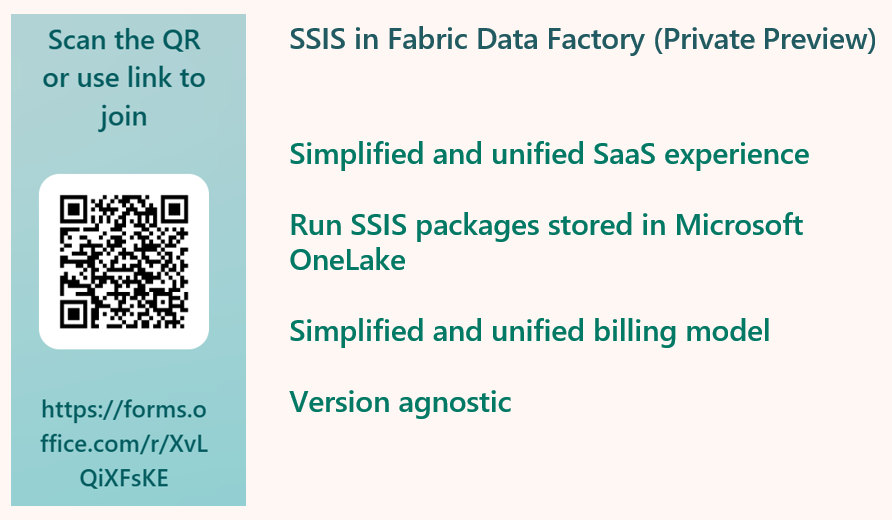
- SSIS Lift & Shift to Fabric Data Factory
- Seamless migration for existing SSIS packages from on-premises/Azure Data Factory into Fabric Data Factory without major ETL rework.
- Reuse existing SSIS logic inside the Fabric ecosystem with consolidated data in OneLake and new features, including Copilot-assisted automation.
- Early access available: Sign Up Form
Modernization Insights: Data Integration in Microsoft Fabric
- Oracle Integration: The Microsoft Connector for Oracle and CDC components are now outside SSIS, requiring transition to modern data flows via Data Factory within Fabric.
- Data Factory Connectivity:
- Connect to Oracle databases (on-premises or behind a VNet).
- Configure copy activity and secure connectivity with the on-premises data gateway.
- Data Factory Oracle connector.
- Move data from Oracle to Lakehouse.
Advanced Change Data Capture (CDC)
- Native CDC in Fabric’s Copy job allows efficient, automatic replication of inserts, updates, and deletes from sources (Oracle and more) to destinations like Fabric Lakehouse/Data Warehouse.
- Zero manual intervention: Change tracking and replication are automated.
- Optimized performance: Only changed data is processed for minimal latency.
- Flexible source support: CDC-enabled and non-CDC sources, watermark-based incremental copy.
- Private Preview available: Copy Job Sign Up Form
Additional Resources
-
[SQL Server Integration Services 2025 General Availability Microsoft Community Hub](https://techcommunity.microsoft.com/blog/ssis/sql-server-integration-services-2025-general-availability/4471157) -
[Tutorial: Integrating SSIS with Fabric Data Warehouse Microsoft Learn](https://learn.microsoft.com/sql/integration-services/fabric-integration/integrate-fabric-data-warehouse?view=sql-server-ver17) -
[Oracle database connector overview – Microsoft Fabric Microsoft Learn](https://learn.microsoft.com/fabric/data-factory/connector-oracle-database-overview) - Move data from Oracle to Fabric Lakehouse via pipeline and on-premises data gateway
- Expanded CDC Support for More Sources & Destinations
Summary: SSIS 2025 delivers data integration modernization by raising security standards, enabling seamless identity management, and offering robust migration/integration options with Microsoft Fabric. Data Factory enhancements, especially for Oracle connectivity and CDC, underscore SQL Server’s evolution into unified cloud analytics. This information is intended for architects, developers, and data engineers modernizing enterprise data infrastructure.
This post appeared first on “Microsoft Fabric Blog”. Read the entire article here