Azure Networking: Latest Updates for Security, Reliability, and AI/ML Workloads
Narayan Annamalai shares the latest Azure networking updates, covering new security, reliability, and scalability features designed for demanding AI and cloud-native workloads, with insights on practical implementation.
Azure Networking: Latest Updates for Security, Reliability, and AI/ML Workloads
Azure networking services are rapidly evolving to meet the exponential growth of AI workloads and the complex requirements of cloud-native applications. Narayan Annamalai provides a detailed overview of Azure Network service innovations—focusing on infrastructure enhancements, security improvements, resilience strategies, and scalability achievements.
Highlights from Azure Networking Advancements
1. AI-Optimized Network Infrastructure
- Azure’s backbone spans 60+ AI regions and 500,000+ miles of fiber, supporting massive scale (18 Pbps WAN capacity).
- The architecture features InfiniBand and high-speed Ethernet for distributed GPU clusters, optimized for intensive AI model training and low-latency inference.
- Dedicated private connections with Azure Private Link, hardware-based VNet appliances, and DPUs enable secure traffic between services and data centers.
2. Security Innovations
- DNS Security Policy with Threat Intelligence: Implements real-time monitoring and blocking of malicious domains, ensuring smart, adaptive network defense (details).
- Private Link Direct Connect: Extends secure connectivity to any routable private IP address (preview), supporting disconnected VNets and SaaS platforms with advanced auditing (details).
- Application Gateway JWT Validation: Layer 7 web app and API protection with native JWT token support, enabling secure, centralized token management (details).
- Forced Tunneling for VWAN Secure Hubs: Inspects outbound internet traffic, routing through designated security appliances for compliance and control (details).
- Web Application Firewall for AKS: Delivers enterprise-grade WAF protection for container workloads, aligning security posture for Kubernetes applications (details).
3. Resilience and Reliability
- Introduction of zone redundant SKUs for NAT Gateway (including new NAT Gateway V2), ExpressRoute, VPN, and Application Gateway enables automatic failover and traffic distribution, supporting robust multi-zone deployment (NAT Gateway V2 blog).
- Standard NAT Gateway V2 offers 100 Gbps throughput, 10 million packets per second, zone redundancy, IPv6 readiness, and traffic logs.
4. Scale for AI and Data Workloads
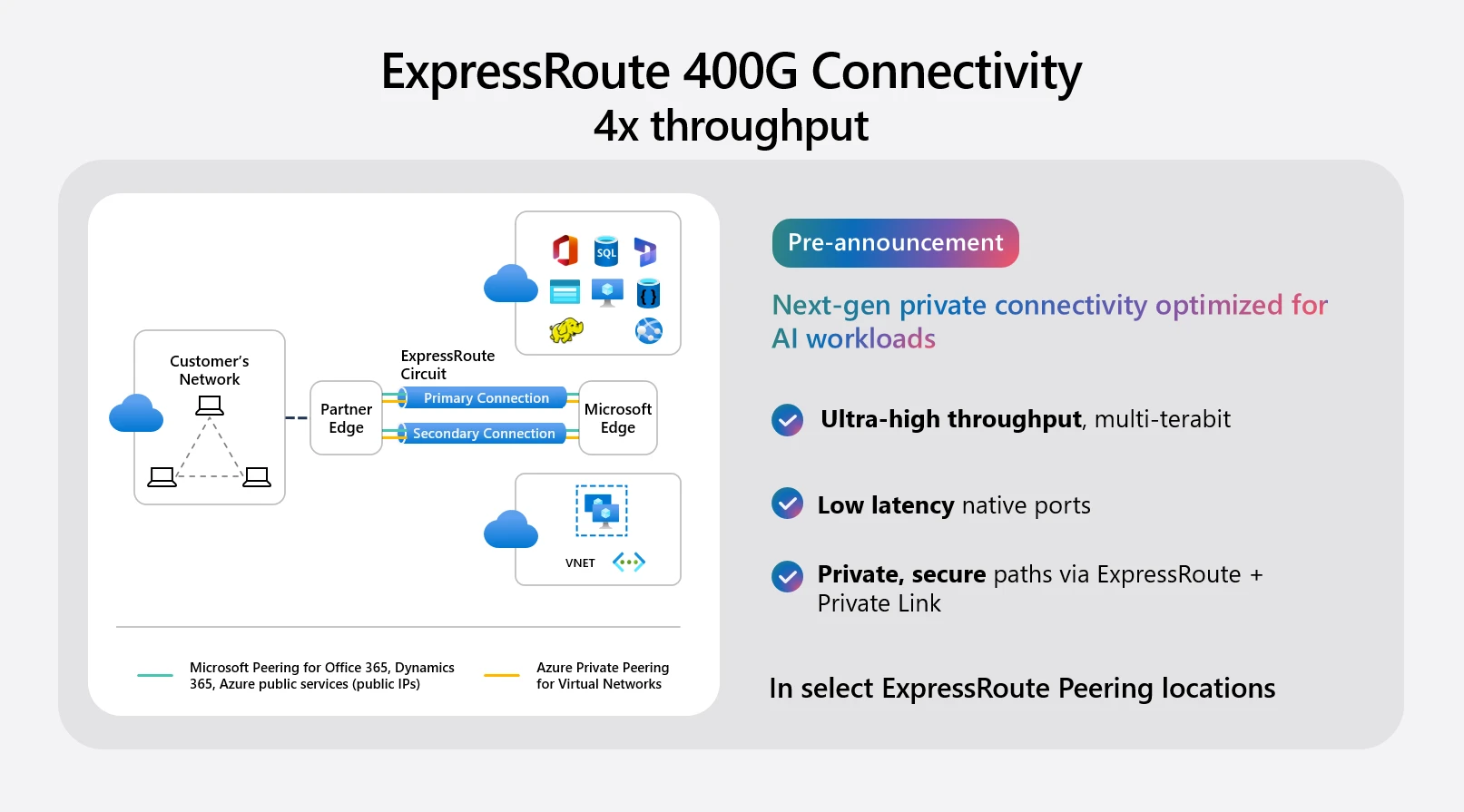
- ExpressRoute 400G: Multi-terabit dedicated connections go live in 2026, enabling reliable high-bandwidth links to datacenters and GPU sites (ExpressRoute info).
- VPN Gateway Updates: GA for 3x faster VPN connectivity (up to 5Gbps per TCP flow, 20 Gbps total throughput across 4 tunnels).
- High Scale Private Link: Supports up to 5,000 private endpoints per VNet and 20,000 cross-peered VNets, enhancing flexible, secure connectivity (Private Link docs).
- Advanced Traffic Filtering: Optimizes storage costs and analysis for traffic logs in Network Watcher (details).
5. Cloud-Native Application Networking
- Advanced Container Networking for AKS:
- eBPF Host Routing boosts throughput and reduces latency by embedding route logic in the Linux kernel (details).
- Pod CIDR Expansion allows scaling by growing pod network address ranges (details).
- WAF for Application Gateway for Containers and Azure Bastion integrations further secure AKS deployments (Bastion private cluster connection).
Getting Started and Additional Resources
Azure Networking empowers organizations to connect, secure, and accelerate digital transformation. For more information and continuous updates, visit the Azure updates page.
Author: Narayan Annamalai
This post appeared first on “The Azure Blog”. Read the entire article here